Our knowledge and wisdom about quantitative bidding and contract evaluation are largely the result of decades of accumulated experience of thousands of bridge players worldwide, from novice to expert. While this forms a reasonable basis in absence of more sophisticated methods, today’s software gives us the ability to dig deeper and be more objective.
I have used a sophisticated hand generator along with Bo Haglund’s Double Dummy Solver to analyze hundreds of thousands of bridge hands, and will present the results in this set of articles. I describe the details of my methods and the assumptions made in a separate article, but present a brief summary here. I have generated a minimum of 10,000 hands for each situation studied, using larger data sets for more complex problems. This reduces the random variations in the result to about 1% either way, which seemed to be a good target after a few studies. The underlying assumption in the analysis is that double dummy results are a reasonable approximation to single dummy ones over a large enough sample size. This assertion has been hotly debated in bridge circles. There is a fair amount of data to support this [REF], and it suggests that single dummy results are slightly better than double dummy for part-score and game contracts, but slightly worse for slams. The difference in all cases is minor.
I don’t take a position on this, nor do I claim that the results here should be taken as the only guide. I suggest you combine the data with your own experience, and decide for yourself whether and how you will tweak your methods.
Some of the findings validate conventional wisdom, and perhaps quantify it. Some of it is surprising, at least to me. I hope you will find this informative and useful, and welcome any feedback and discussion.
When partner opens 1N, his hand is restricted to a narrow point range and a handful of shapes. This allows for very accurate bidding, and there is usually enough space to explore the right contract. This also is one of the simplest cases for simulation-based analysis. We will look at a number of questions:
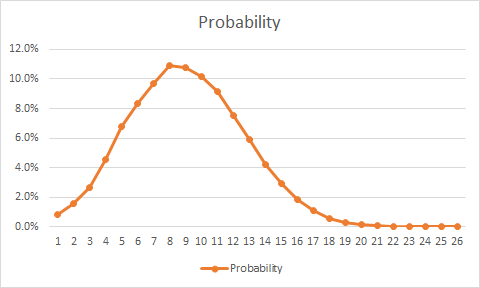
No surprises here. Responder’s most likely point count is 8, and the probabilities follow the graph below:
As for distributions, 4432 is the most likely and, overall, the more balanced distributions dominate. The table below gives the top ten shapes:
Shape | Probability | Shape | Probability | |
4-4-3-2 | 23.1% | 6-3-2-2 | 5.2% | |
5-3-3-2 | 16.1% | 6-4-2-1 | 4.2% | |
5-4-3-1 | 12.7% | 6-3-3-1 | 3.2% | |
4-3-3-3 | 11.6% | 4-4-4-1 | 3.1% | |
5-4-2-2 | 10.6% | 5-5-2-1 | 2.9% | |
If you look for specific distributions (for instance, 4 spades, 4 hearts, 3 diamonds, and 2 clubs rather than any 4432), the picture changes a bit. Now 4333 rises to the top, and the top ten are:
Specific | Probability | Specific | Probability | |
4-3-3-3 | 2.9% | 5-4-3-1 | 0.5% | |
4-4-3-2 | 1.9% | 6-3-2-2 | 0.4% | |
5-3-3-2 | 1.3% | 6-3-3-1 | 0.3% | |
5-4-2-2 | 0.9% | 5-5-2-1 | 0.2% | |
4-4-4-1 | 0.8% | 6-4-2-1 | 0.2% | |
A few decades ago, we were taught that when both hands are balanced, we needed a total of 26 points to bid a sound NoTrump game. Today most people think that 25 is enough and many will even bid with 24. So what does the data tell us? And all other things being equal, is it better to have a 4333, 4432, or 5332 shape? How much difference does the shape make?
The table below summarizes the probability for game with a combined 24, 25, and 26 points between the two hands. The NT opener has any shape (4333, 4432, or 5332). For responder, we look at each shape separately. Each data point in the table below is calculated over 10,000 deals.
Total Points | 24 | 25 | 26 | ||||||
Resp shape | 4333 | 4432 | 5332 | 4333 | 4432 | 5332 | 4333 | 4432 | 5332 |
Openr Pts |
|
|
|
|
|
|
|
|
|
12 | 38.0% | 35.8% | 40.5% | 56.2% | 54.4% | 57.7% | 73.2% | 70.0% | 75.3% |
13 | 36.8% | 35.8% | 41.4% | 56.8% | 54.9% | 58.8% | 74.7% | 71.2% | 74.9% |
14 | 35.8% | 34.6% | 40.9% | 58.5% | 54.6% | 59.5% | 74.5% | 70.8% | 76.1% |
15 | 35.7% | 33.8% | 39.9% | 55.7% | 55.0% | 60.2% | 74.4% | 71.8% | 75.1% |
16 | 35.1% | 36.1% | 38.9% | 54.6% | 53.8% | 58.1% | 73.2% | 71.9% | 75.6% |
17 | 33.0% | 32.4% | 37.9% | 53.6% | 52.4% | 58.1% | 74.0% | 71.8% | 75.5% |
18 | 31.5% | 32.1% | 35.1% | 51.2% | 53.4% | 56.5% | 72.3% | 71.4% | 74.4% |
19 | 28.0% | 30.4% | 33.5% | 52.3% | 50.7% | 53.8% | 71.9% | 72.5% | 73.8% |
A few important observations here:
Armed with the above knowledge about point-counts and game odds, we can ponder the questions of when to invite game, when to accept, and when to just blast to game. The answer, obviously, depends on whether you are playing IMPs, match-points, or Board-a-Match and, for IMPs, on the vulnerability. I will spare you the details of the analysis, but will explain a few key issues. We assume that responder has no four-card major and either 4333, 4432, or 5332 shape.
We have all heard that vulnerable games are worth bidding if 35% or better, non-vul if 45% or better, and match-points or BAM at 50%. The first thing to understand that this is only half true. These odds apply if the only possible contracts are game and one level below game., and the only results are making (perhaps with overtricks) or down one. Real life is much more complex. Consider the decision of inviting via 2N when partner opens 1N, vulnerable at IMPs. For this to gain, not only must game be making, but partner must be strong enough to accept. In these cases, you will gain 10 IMPs. As against that, you will lose in the following scenarios:
In the non-vul case, the possible gain is 6 IMPs, and the losses for the above cases are 5, 5, 3, 4, and 2 IMPs respectively. The BAM calculations will really vary depending on whether the other table will pass, invite, or bid game directly, while the match-point results will depend on how many people go with each action.
All of this is way too complex to work through in detail in such an article, let alone to figure out on the table, so I will just give you the resulting recommendations instead, for a 15-17 NT opening. The results can be extrapolated for a 12-14 opening by giving responder three more points.
The following table summarizes the average gain or loss per deal for each action at all forms of scoring, vulnerability, and responder’s point-counts and shapes (winning actions in bold):
Responder shape | Responder Points |
Effect of inviting vs passing |
Effect of bidding game vs passing |
Match-point results
| ||||||
BaM | VUL | NV | BaM | VUL | NV | Pass | Invite | Bid Game | ||
4333 | 8 | -0.26 | -0.34 | -0.73 | -0.35 | -0.93 | -1.28 | 43% | 33% | 23% |
9 | 0.04 | 1.78 | 0.72 | 0.02 | 2.05 | 0.65 | 32% | 36% | 32% | |
10 | 0.28 | 3.46 | 1.89 | 0.37 | 4.94 | 2.57 | 23% | 37% | 40% | |
4432 | 8 | -0.26 | -0.31 | -0.69 | -0.34 | -0.85 | -1.20 | 43% | 33% | 23% |
9 | 0.01 | 1.59 | 0.61 | -0.01 | 1.79 | 0.51 | 33% | 36% | 31% | |
10 | 0.24 | 3.27 | 1.75 | 0.35 | 4.77 | 2.48 | 23% | 37% | 40% | |
5332 | 8 | -0.21 | 0.09 | -0.41 | -0.26 | -0.21 | -0.76 | 41% | 34% | 25% |
9 | 0.07 | 2.01 | 0.90 | 0.06 | 2.61 | 1.07 | 31% | 36% | 33% | |
10 | 0.28 | 3.58 | 1.97 | 0.43 | 5.40 | 2.91 | 21% | 37% | 42% | |
Is an 8-card major suit fit always better than NT? Should responder use stayman with 4-3-3-3 or 3-4-3-3? Here we find that conventional wisdom largely serves us well. When responder has a 4333 shape and opener has 4 or 5 cards in responder’s major, 3N is the better choice at all forms of scoring. On an average, 4S scores about 0.7 IMPs worse than 3N when vulnerable, 0.5 IMPs worse when not; match-point expectancy of playing in the major is about 48% vs 52% for 3N. Add to this the information revealed to the opponents (whether or not a 4-4 major fit is found) and the choice is not even close: DO NOT use stayman when 4333.
What about puppet stayman, to check if we have a 5-4 fit? Here the results are less consistent, but overall, 3N plays better even with a 5-4 major fit. The situation gets reversed when the combined strength is over 26 points. In this case, game is extremely likely, and the biggest danger is one suit being wide open. In this case, the major suit game tends to be safer, provided the suit is of good quality.
When responder holds a 4432 shape, however, the pendulum swings the other way. Now the 4-4 (or 5-4) major fit plays 1.6 IMPs better when vulnerable and 1.4 IMPs better when not; at matchpoints the average score is 66% in the major suit game against 34% in 3N.
Finally, what about 5332 with the responder? The conventional wisdom is to transfer to the major and then bid 3N, offering a choice of games. Opener typically passes with a doubleton and reverts to the major with 3-card support. This too, is amply vindicated by the simulations. The one exception is when opener is 4333, in which case 3N tends to play better at all forms of scoring.
This is where things get interesting. Partner opens 1N and you are looking at fewer than 8 points and an unbalanced hand. Should you pass or try to find a better spot?
Let us start with a 4-4-4-1 shape with a stiff club. You have the option of bidding 2C and passing whatever partner bids. Some systems also use 1N-2C-2D-2H as pass or correct, not allowing opener to go higher than 2 of a major. Let us call this Pick-a-Major. It turns out that either of these actions is superior to passing 1N, and Pick-a-Major is slightly better than Stayman-and-Pass.
Stayman-and-Pass vs play in 1N | Pick-a-major vs play in 1N | |||||||
Resp Pts | BAM / Pairs | IMPs Vul | IMPs NV | Resp Pts | BAM / Pairs | IMPs Vul | IMPs NV | |
0 | 77% | 2.98 | 1.93 | 0 | 77% | 2.98 | 1.93 | |
1 | 75% | 2.91 | 1.94 | 1 | 75% | 2.92 | 1.94 | |
2 | 76% | 3.15 | 2.19 | 2 | 77% | 3.17 | 2.20 | |
3 | 71% | 2.35 | 1.74 | 3 | 71% | 2.38 | 1.77 | |
4 | 71% | 2.24 | 1.72 | 4 | 73% | 2.33 | 1.82 | |
5 | 68% | 1.72 | 1.40 | 5 | 72% | 1.89 | 1.57 | |
6 | 65% | 1.45 | 1.22 | 6 | 72% | 1.70 | 1.47 | |
7 | 62% | 1.11 | 0.98 | 7 | 72% | 1.46 | 1.33 | |
Total | 67% | 1.77 | 1.39 | Total | 73% | 1.96 | 1.59 | |
This is good, since Pick-a-Major is useful even when the singleton is in Diamonds (4-4-1-4). The weaker your hands, the higher the benefits (with some minor statistical anomalies) of playing in a suit contract.
What should we do, however, with a major suit singleton, that is, with a 4-1-4-4 or 1-4-4-4. Are we resigned to playing in 1N? What if we transferred to the major instead? Let us look at the data.
Transfer to 4-card Major vs play in 1N | |||
Resp Pts | BAM/Pairs | IMPs Vul | IMPs NV |
0 | 57% | 1.23 | 0.81 |
1 | 60% | 1.43 | 0.97 |
2 | 59% | 1.33 | 0.95 |
3 | 55% | 0.53 | 0.46 |
4 | 54% | 0.38 | 0.39 |
5 | 53% | 0.08 | 0.18 |
6 | 54% | 0.07 | 0.18 |
7 | 54% | 0.05 | 0.16 |
Total | 54% | 0.28 | 0.31 |
Transferring on a four-card suit -- what won’t they come up with next? This is so counter-intuitive it deserves more attention. Transferring pays off when opener turns up with four or five card support, and loses when opener has only two. With three trumps, it is practically a wash. What tilts the balance is that when you hold a four-card suit, the chances of the notrump opener having a doubleton (22%) are lower than their holding four or more cards (30%), which makes the transfer more likely to succeed overall.
So should we really transfer with a four-card suit on a weak 4-1-4-4- or 1-4-4-4? Not so fast … there is another factor to consider. Many players will “super-accept” a transfer with four or five card support, thus pushing us to the three level. This completely nullifies the advantages of the four-card transfer, and the average results are almost a wash whether you transfer or not. Transferring still helps a little when you are very weak (0-2 points), but loses a little for better hands. You are probably better off playing with the field and passing 1N.
Of course, if your style is not to super-accept, you can get a slight edge by transferring with these hands.
If you have followed the previous analysis, you will guess that the percentage action must be to try to improve the contract. Indeed, the results validate this. When your shape is 3-4-5-1 or 4-3-5-1, your best bet is to bid Stayman and pass the response. This wins at all forms of scoring and vulnerability. The table below gives the expected gains for this action over passing a 15-17 NT opening.
Responder Point Count | ||||||||||
Resp shape | Scoring | 0 | 1 | 2 | 3 | 4 | 5 | 6 | 7 | Average |
3-4-5-1 | Vul IMPs | 3.61 | 3.80 | 3.76 | 3.40 | 2.93 | 2.53 | 1.85 | 1.37 | 2.32 |
Non-Vul IMPs | 2.33 | 2.50 | 2.58 | 2.47 | 2.23 | 2.01 | 1.54 | 1.19 | 1.81 | |
Match Points | 85% | 81% | 80% | 81% | 79% | 78% | 75% | 71% | 76% | |
4-3-5-1 | Vul IMPs | 3.44 | 3.57 | 3.43 | 3.18 | 2.69 | 2.38 | 1.71 | 1.24 | 2.15 |
Non-Vul IMPs | 2.22 | 2.35 | 2.35 | 2.31 | 2.05 | 1.89 | 1.42 | 1.08 | 1.67 | |
Match Points | 84% | 79% | 78% | 79% | 77% | 77% | 74% | 70% | 75% | |
Not surprisingly, the gains are biggest when responder is weakest, but we see gains across the board. Occasionally, we may play in a 4-3 major or 5-2 diamond fit, but more often than not, we will find an eight-card fit. It is also important to note that the gains are more for 3-4-5-1 than for 4-3-5-1. This is because opener responds 2H with four cards in each major, which means that with 4-3-5-1 you will occasionally play in a 4-3 spade fit rather than a 4-4 heart fit.
What if your singleton is diamond? The stayman-and-pass option is no longer viable. There is some hope if you play stayman followed by 3C as weak -- not a popular treatment. If you do, you are in luck, since you can pass a 2-major response and bid 3C over 2D. This gives you the following gains:
Responder Point Count | ||||||||||
Resp shape | Scoring | 0 | 1 | 2 | 3 | 4 | 5 | 6 | 7 | Average |
3-4-1-5 | Vul IMPs | 2.81 | 2.63 | 2.78 | 2.45 | 2.09 | 1.86 | 1.30 | 0.98 | 1.68 |
Non-Vul IMPs | 1.81 | 1.69 | 1.90 | 1.77 | 1.61 | 1.51 | 1.12 | 0.89 | 1.33 | |
Match Points | 77% | 72% | 72% | 72% | 72% | 73% | 71% | 68% | 71% | |
4-3-1-5 | Vul IMPs | 2.64 | 2.41 | 2.45 | 2.23 | 1.85 | 1.71 | 1.16 | 0.86 | 1.50 |
Non-Vul IMPs | 1.70 | 1.55 | 1.67 | 1.61 | 1.43 | 1.39 | 1.00 | 0.79 | 1.19 | |
Match Points | 76% | 70% | 70% | 71% | 70% | 72% | 70% | 67% | 70% | |
The gains are smaller than in the singleton club case, since you now have to bid at the 3 level when there is no major suit fit. But, here too, the gains are across the board. As in the previous case, the gains are highest when responder is weakest, and higher with 3-4-1-5 than with 4-3-1-5. Maybe you should be playing 3C weak in this auction?
But most people play 3C as forcing, so what do they do with this hand? You have three choices -- Pass, transfer to 3C, or, heaven forbid, transfer to your 4-card major. All three are very close overall, as the table below shows:
Responder Point Count | ||||||||||
Scoring | Action | 0 | 1 | 2 | 3 | 4 | 5 | 6 | 7 | Average |
Vul IMPs | Transfer to Major | 1.13 | 1.22 | 1.59 | 1.02 | 0.80 | 0.72 | 0.19 | 0.15 | 0.55 |
With Superaccepts | 0.28 | 0.46 | 0.63 | 0.31 | 0.09 | 0.16 | -0.20 | -0.06 | 0.06 | |
Transfer to 3 Minor | 1.48 | 1.41 | 0.91 | 0.97 | 0.50 | 0.24 | -0.27 | -0.32 | 0.16 | |
Non-Vul IMPs | Transfer to Major | 0.74 | 0.81 | 1.13 | 0.80 | 0.68 | 0.65 | 0.28 | 0.24 | 0.51 |
With Superaccepts | 0.20 | 0.31 | 0.44 | 0.28 | 0.14 | 0.23 | -0.03 | 0.08 | 0.14 | |
Transfer to 3 Minor | 0.95 | 0.90 | 0.59 | 0.68 | 0.38 | 0.20 | -0.20 | -0.25 | 0.11 | |
Match Points | Transfer to Major | 59% | 59% | 61% | 58% | 58% | 59% | 56% | 55% | 57% |
With Superaccepts | 53% | 55% | 55% | 53% | 52% | 54% | 53% | 54% | 53% | |
Transfer to 3 Minor | 63% | 64% | 57% | 60% | 57% | 56% | 50% | 48% | 53% | |
As before, the advantage of transferring to the major is nullified if you play “super-accepts”, and transferring to 3 of the minor becomes a little more attractive. The weaker the responder, again, the more attractive is the minor suit transfer. In fact, with 6 or 7 points, you are better off passing the 1N at IMPs.
This analysis is not only valid for 3-4-1-5 and 4-3-1-5, it also applies when the singleton is a major. Again, you have the same options of Pass, Transfer to the 4-card Major, and Transfer to 3 of the Minor, and the gains of the transfers are exactly the same as above.
We have seen it is best to get out of 1N with weak, unbalanced hands, but what about balanced hands? Obviously, no one will think of bidding with 4333’s, and most would pass with a weak 4432 as well. But they would be wrong, as we will see below.
The analysis follows the previous cases. With 4-4 in both majors, the winning action is to bid Stayman, followed by a pass-or-correct 2H over 2D. With a 4-3-4-2 or 3-4-4-2, best is to bid Stayman and pass the response. As in the previous examples, the weaker hands have more to gain, and the 3-4-4-2 does better than the 4-3-4-2. If your doubleton is in a major, however, or if you have 4-3-2-4 or 3-4-2-4 shape, there is no safe way to get to a better fit, and you are best off passing 1N. The table below shows the gains with the different patterns:
Responder Point Count | ||||||||||
Resp shape | Scoring | 0 | 1 | 2 | 3 | 4 | 5 | 6 | 7 | Average |
4-4-3-2 or 4-4-2-3 | Vul IMPs | 2.09 | 1.46 | 1.47 | 1.39 | 1.16 | 0.87 | 0.69 | 0.59 | 0.92 |
Non-Vul IMPs | 1.30 | 0.94 | 0.98 | 1.00 | 0.90 | 0.74 | 0.64 | 0.58 | 0.76 | |
Match Points | 72% | 64% | 64% | 65% | 64% | 65% | 64% | 62% | 64% | |
4-3-4-2 | Vul IMPs | 1.98 | 1.13 | 1.06 | 1.06 | 0.71 | 0.40 | 0.21 | 0.00 | 0.45 |
Non-Vul IMPs | 1.23 | 0.72 | 0.71 | 0.76 | 0.56 | 0.36 | 0.22 | 0.05 | 0.36 | |
Match Points | 71% | 60% | 59% | 61% | 59% | 57% | 55% | 50% | 56% | |
3-4-4-2 | Vul IMPs | 2.02 | 1.03 | 1.04 | 1.07 | 0.71 | 0.39 | 0.16 | 0.01 | 0.44 |
Non-Vul IMPs | 1.26 | 0.66 | 0.69 | 0.77 | 0.56 | 0.35 | 0.17 | 0.06 | 0.35 | |
Match Points | 71% | 59% | 59% | 61% | 58% | 56% | 54% | 50% | 55% | |
Note that the gains are smaller than with 4441 or 4351 shapes, as you would expect, but you still see gains across the board. The gains for 4-3-4-2 and 3-4-4-2 all but disappear when responder has 7 points.